
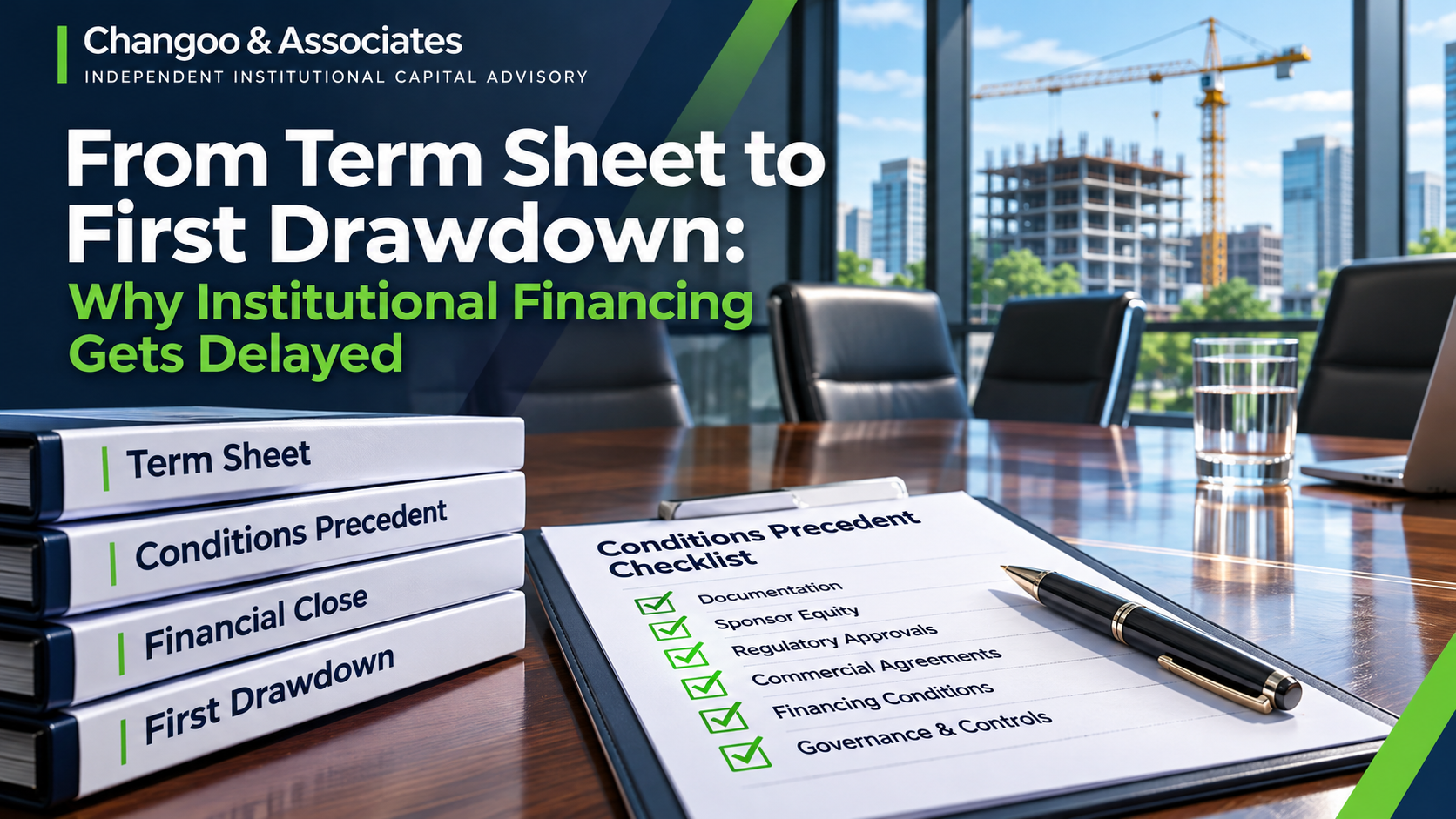
From Term Sheet to First Drawdown: Why Institutional Financing Gets Delayed
By Dale C. Changoo
Managing Principal, Changoo & Associates
Institutional Capital Advisory | Transaction Structuring | Governance
A Financing Indication Is Not Available Capital
Project finance conditions precedent can determine whether financing documents become effective, whether financial close can occur, and whether capital is available for an initial or subsequent drawdown. They are a central reason why progress from negotiated financing terms to actual funding can be more complicated than a sponsor initially expects.
A project sponsor may receive an indicative term sheet, negotiate commercial terms, or execute financing documents without having immediate access to the proposed funds. Each milestone has a different legal and practical significance. The precise requirements depend on the financing structure and the definitive transaction documents.
An indicative financing proposal is not necessarily a binding commitment. Similarly, execution of financing agreements does not automatically establish that every condition governing disbursement has been satisfied.
The essential question is therefore not simply whether financing has been offered or documented. It is:
What must be completed, who is responsible, and what evidence must be accepted before the next financing milestone can occur?
Answering that question requires coordination across legal, financial, technical, commercial, insurance, banking, and governance workstreams.
Three Financing Milestones That Should Not Be Confused
1. Indicative Financing Terms
An indicative proposal may describe a contemplated funding amount, pricing, tenor, security, covenants, conditions, and timetable. Some provisions may be binding, while the principal funding terms remain subject to credit approval, underwriting, documentation, or other requirements.
Sponsors should distinguish an expression of interest from indicative terms, internal credit approval, and a legally enforceable financing commitment. These are different stages and should not be presented as equivalent evidence of available capital.
2. Financial Close
In many project-finance transactions, financial close refers to the milestone at which definitive financing arrangements are executed and the requirements specified for that milestone are met. Its contractual definition can vary across transactions, jurisdictions, and financing structures.
Financial close should not be assumed to mean that every future funding condition has been discharged. A facility may require additional documents, certifications, or confirmations before its first utilization or later drawdowns.
3. Initial and Subsequent Drawdowns
A drawdown is a utilization or release of funds under the applicable financing agreement. Conditions for a particular drawdown may include evidence of sponsor equity, agreed security and account arrangements, insurance, construction progress, technical certifications, compliance with representations, or other contractual requirements.
Some requirements apply only to the first drawdown. Others recur for each utilization. The financing agreements determine the timing, acceptance standards, and consequences of non-compliance.
Project Finance Conditions Precedent: An Execution-Control Framework
Project finance conditions precedent are often treated as a legal checklist. In practice, satisfying them can depend on the coordinated actions of sponsors, lenders, counsel, accountants, engineers, insurers, banks, contractors, and other transaction participants.
An effective process must identify both the required deliverable and the underlying dependency that could prevent its completion.
Common categories include:
- Corporate authority and legal capacity. Formation and organizational records, ownership and beneficial-ownership information, approvals, execution authority, and required legal opinions.
- Sponsor equity and capitalization. Evidence of contributed or committed equity, availability of the required funding, and compliance with equity-first or proportional-funding arrangements, where applicable.
- Asset rights and project permissions. Land rights, concessions, title, licenses, permits, environmental approvals, and other rights necessary to develop or operate the project.
- Project and commercial agreements. Construction, supply, offtake, operating, concession, and other material agreements supporting project delivery, revenues, and risk allocation.
- Security and financial controls. Security documents, registrations or perfection steps, controlled accounts, reserve mechanisms, and cash-management arrangements.
- Insurance and risk protection. Required policies, endorsements, guarantees, performance security, and other agreed mitigants.
- Independent confirmations. Technical, engineering, cost, environmental, or other professional reviews and certifications required by the agreements.
- Utilization and ongoing compliance. Drawdown notices, financial calculations, representations, certificates, and confirmations applicable to the relevant funding release.
These categories are illustrative, not universal requirements.
The definitive financing documents determine which conditions apply, when they apply, and who has the authority to accept or waive them.
Why Financing Processes Become Delayed
A financing delay is not always caused by an unusually long document checklist. More often, the difficulty lies in the sequence of approvals, documents, and third-party actions required to satisfy the checklist.
Consider a sponsor that must establish controlled financing accounts before the initial drawdown. Account opening may depend on completed ownership records, bank onboarding, authorized signatories, executed security documents, and arrangements agreed with the financing counterparties. What appears to be one administrative item can therefore contain several critical-path dependencies.
Another common structural challenge is circularity: a construction contractor may require confidence that financing is available before signing definitive obligations, while a proposed lender may require an executed construction contract before making funds available. The parties must resolve that dependency through an agreed sequence or other acceptable contractual arrangements.
Managing project finance conditions precedent consequently requires more than collecting documents. It requires mapping dependencies, assigning owners, coordinating review and acceptance, and escalating issues that could block the next transaction milestone.
A checklist identifies what must be delivered. A critical-path execution plan establishes how, by whom, and in what order the requirements can be completed.
A Practical Conditions-Precedent Control Register
Sponsors should maintain a single authoritative register of material conditions, while distinguishing requirements for financial close from those governing the initial drawdown and subsequent utilizations.
Each condition should record:
- Contractual reference: The relevant agreement, clause, schedule, or formal requirement.
- Required deliverable: The exact document, certification, action, or event.
- Accountable owner: The person or organization responsible for completion.
- Supporting parties: Counsel, accountants, technical advisers, insurers, banks, or other contributors.
- Dependencies: Prior approvals, documents, or decisions required for completion.
- Target date: The contractual deadline or agreed execution milestone.
- Evidence location: The controlled data-room location or document reference.
- Submission status: Not started, in preparation, submitted, under review, or returned for correction.
- Acceptance or waiver status: Accepted, validly waived, or outstanding, as determined under the documents.
- Blocking issue and next action: Material defect, escalation owner, and proposed resolution.
A critical distinction is the difference between internally prepared, submitted, and formally accepted. An item that a sponsor considers complete may not satisfy the documentary requirements of the financing counterparty.
The register should separately identify the party authorized under the transaction documents to determine satisfaction or grant a waiver. Project managers and advisers may coordinate evidence, but they do not acquire lender approval authority simply by administering the register.
Download the Conditions Precedent & First Drawdown Tracker
Changoo & Associates has prepared an editable Excel workbook to help project sponsors and transaction advisers organize financing conditions, documentary evidence, accountable parties, approval requirements, and drawdown dependencies.
The workbook contains an execution dashboard, a conditions-precedent register, a first-drawdown checklist, and usage instructions. It is designed as a transaction-planning aid rather than a substitute for any financing agreement.
Download the Conditions Precedent & First Drawdown Tracker (Excel)
The workbook contains illustrative requirements. Users must adapt it to the definitive agreements, responsible counterparties, and applicable approval procedures of their own transactions. The presence of an item in the workbook does not establish that it is a condition of any particular financing.
Illustrative Example: A Delayed First Drawdown
Consider a hypothetical infrastructure development with negotiated financing terms and executed principal financing documents. The sponsor expects an initial release of funds for mobilization and development expenditures.
Five matters remain unresolved:
- The evidence supporting the final sponsor equity contribution has not been accepted.
- A material project agreement remains subject to a required approval.
- The insurance package does not yet meet the contractual requirements.
- Financing-account and security arrangements remain incomplete.
- An independent technical certificate has not been finalized.
The sponsor may consider each item relatively minor. Taken together, however, they may prevent funding if the definitive agreements require their completion before utilization.
The correct response is not automatically to restart financing discussions. It is to establish which requirements apply to the proposed drawdown, identify who can resolve and accept them, prioritize critical dependencies, and implement a coordinated completion process.
This example is hypothetical and does not describe a client engagement or a specific financing transaction.
Five Controls That Strengthen Financing Execution
1. Maintain one authoritative register. Avoid inconsistent conditions-precedent lists circulating among sponsors, legal counsel, advisers, and financing counterparties.
2. Sequence activities by dependency, not document count. A condition requiring several approvals may be more urgent than a larger number of straightforward administrative items.
3. Assign ownership and control document versions. Each condition needs an accountable owner and a traceable record of the current evidence.
4. Distinguish submission from formal acceptance. Track the review outcome and any permitted waiver separately from the sponsor’s internal progress assessment.
5. Escalate critical-path deficiencies promptly. Outstanding equity, security, contract, permit, insurance, or technical issues should be identified before they threaten the intended financing date.
These controls improve transparency and accountability. They do not replace the definitive agreements or the judgment of parties entitled to enforce them.
When Is a Transaction Ready to Advance?
A transaction may be ready to proceed to its next financing stage when the applicable conditions are clearly identified, responsibilities have been allocated, material dependencies have credible resolution pathways, and required evidence can be reviewed within a workable timetable.
Where substantive legal, commercial, financial, or technical conditions remain unresolved, additional preparation may be necessary before financial close or a funding release can occur.
The objective is not to eliminate every commercial risk. It is to understand the requirements of the relevant milestone, establish whether they can be met, and present reliable evidence to the parties authorized to review it.
From Financing Structure to Funding Execution
Institutional financing readiness does not end with an attractive financial model, an appropriately structured capital stack, or an indicative term sheet.
It also requires a credible pathway through the documentary, contractual, approval, and operational requirements governing financing effectiveness and utilization. Project finance conditions precedent are therefore an execution-management responsibility as well as a legal-documentation matter.
A financing structure explains how capital is intended to work. Execution readiness demonstrates whether the conditions governing its deployment can be satisfied.
For a broader assessment of transaction preparation, read our Eight-Gate Institutional Capital Readiness Checklist.
About the Author
Dale C. Changoo is Managing Principal of Changoo & Associates, a Toronto-based independent institutional advisory firm specializing in capital readiness, transaction structuring, governance, diligence coordination, and execution planning.
He is the author of the three-volume Institutional Capital Readiness Series.
Further resources
- Institutional Advisory Services
- Dale C. Changoo — Professional Biography
- Institutional Capital Readiness Series
- World Bank — Achieving Contract Effectiveness and Financial Close
- IFC — Project Cycle
Disclaimer: This article and its companion workbook are intended for educational and transaction-planning purposes only. They do not constitute a financing commitment or legal, tax, securities, regulated investment, or transaction-specific financing advice. The interpretation, satisfaction, acceptance, and waiver of financing conditions depend on the definitive agreements, applicable law, jurisdiction, and circumstances of each transaction.